

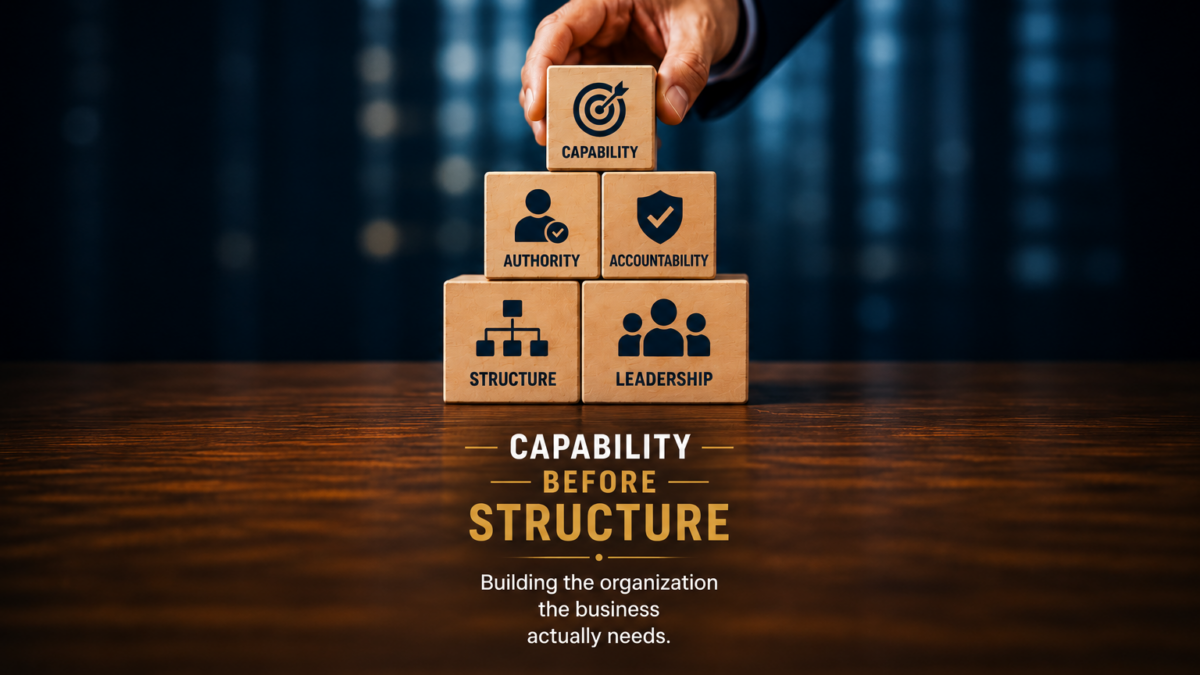
Growing organizations eventually reach a point where the structure that helped build the business is no longer sufficient to support where the business needs to go next.
The natural response is often to think in terms of roles.
We need a VP of Sales.
We need a Chief Revenue Officer.
We need another layer of management.
But that may be starting with the wrong question.
Before determining who the business needs to hire, leadership should first understand what the business needs to be capable of doing that it cannot consistently do today.
That distinction matters.
Far too often, organizations attempt to manifest the organizational structure they believe a mature company should have. Roles are created, seniority levels established and recruiting begins before there is sufficient clarity around the capabilities, authority and outcomes the business actually requires.
The result can be an impressive-looking organizational chart that does very little to solve the underlying business problem.
Start With the Business Need
A title is not a capability.
Hiring a VP of Sales does not automatically create sales strategy. Adding a senior leader does not necessarily create operational discipline. Creating another management layer does not guarantee better execution.
The first questions should be more fundamental.
What does the business need to accomplish over the next 12, 24 or 36 months?
What capabilities are missing today?
Where is execution breaking down?
What decisions aren’t being made?
What expertise does the existing team lack?
Where does accountability need to reside?
And perhaps most importantly, does the business need someone primarily working in the business, or someone working on the business?
There can certainly be overlap between the two, but they fundamentally serve different objectives.
Someone working in the business may be responsible for managing people, opportunities, customers, forecasts and day-to-day execution.
Someone working on the business may be expected to evaluate the operating model, establish strategy, redesign processes, define go-to-market priorities, build organizational capability or prepare the company for its next stage of growth.
Those are different expectations. They require different competencies, measures of success and often very different levels of investment.
Understanding which problem you are actually trying to solve should come before deciding what title belongs on the organizational chart.
When Structure Begins to Work Against the Business
Personal experience has afforded me the opportunity to see both ends of this spectrum in real time.
I have seen span of control become more important than the natural operating rhythm of the business.
Departments can be created because the organizational structure says they should exist, including leaders responsible for functions with no direct reports. Teams can be aligned beneath departments where there is little natural operating connection simply because the structure appears logical on paper.
Eventually, the organization starts serving the organizational chart instead of the organizational chart serving the business.
The consequences aren’t always immediately visible.
Information begins travelling through unnatural paths. Decisions require participation from people who have little connection to the outcome. Accountability becomes distributed. Collaboration becomes more difficult. What should be a straightforward operating conversation becomes an exercise in navigating structure.
And inevitably, there is a human dimension.
Politics and ego exist in almost every organization, and managing both is part of leadership. But when structure reinforces them, they can become toxic to the culture and operating effectiveness of the business.
Long-tenured leaders can sometimes develop a scarcity or hoarding mindset around responsibilities, information, relationships or decision-making authority. What may have originated from commitment to the organization can eventually become a desire to protect territory.
That makes organizational evolution considerably more difficult.
The question stops being simply:
What does the business need?
It becomes:
Who owns what? Who controls what? And what might someone perceive they are losing if the structure changes?
Those are very different conversations.
When the Role and the Need Don’t Match
Misalignment at the hiring stage compounds these problems.
An organization may recruit a strategic executive and then expect that person to function primarily as a frontline operator.
Or it may hire an operational leader and expect them to redesign the business.
The individual believes they were hired to accomplish one thing. The founder or executive team expects something different. Employees receive inconsistent direction. Decision-making authority remains unclear.
Eventually, accountability becomes equally unclear.
The problem may appear to be performance.
The underlying problem may actually be role design.
When responsibilities, authority, expectations and measures of success aren’t aligned from the beginning, even highly capable people can struggle to produce the desired outcome.
That is why organizations should inject the capabilities the business needs, rather than simply adding roles that reflect a perception of what the organization should look like.
The Founder-Led Business Makes This More Complicated
This challenge becomes particularly pronounced in startups and small-to-medium-sized organizations, especially businesses that remain heavily founder or owner led.
During the early stages of a company, adaptability is an enormous advantage.
Everyone does what needs to be done.
Founders sell, manage customers, develop strategy, recruit employees, solve operational problems and make most of the important decisions. Early leaders often operate well outside the conventional boundaries of their titles.
That flexibility helps build the business.
But it can also create an expectation that every future leader should operate the same way.
As the company grows, that becomes increasingly difficult.
A senior executive can certainly adapt to changing business requirements. But there still needs to be clarity around what that individual is ultimately accountable for, what authority accompanies that accountability and what outcomes define success.
Otherwise, the organization risks hiring experienced leaders while continuing to operate as though every meaningful decision still belongs to the founder.
One of the most thoughtful examples of this came from a U.S. CEO I worked with earlier in my career who became a mentor and coach, and today is a personal friend. He was both the founder and CEO of a highly successful organization he had spent years building.
At one point, he made the decision to step away from leading the business.
It wasn’t because his passion for the company had diminished. It wasn’t because he had lost interest in the role or stopped believing in what the organization could become.
During one of our conversations, he explained something that has stayed with me: he had begun to question whether he himself might be becoming a bottleneck preventing the business from evolving to its next stage.
There is considerable leadership maturity in being willing to ask yourself that question.
The characteristics that allow a founder to build a successful company—deep involvement, conviction, decisiveness, intimate customer relationships and a willingness to personally influence almost every aspect of the business—can be tremendous advantages during one stage of growth.
At another stage, some of those same characteristics can unintentionally constrain the organization.
Recognizing that doesn’t diminish what the founder built. In many ways, it demonstrates the opposite.
Sometimes the next act of leadership isn’t deciding what else you need to control. It’s recognizing what the organization can now accomplish without you controlling it.
That principle extends well beyond founders. Every senior leader should periodically ask whether their involvement is accelerating the people around them or inadvertently creating dependency on them.
Autonomy Is More Than Delegation
Some of my earliest leadership lessons showed me what the alternative could look like.
Early in my career in Montreal, I had the good fortune to work for and with two CEOs who demonstrated a very different philosophy.
They delegated.
They provided genuine autonomy.
And importantly, they did not view every failure as evidence that authority needed to be taken back.
Failure could instead become a real-time opportunity to coach, mentor and develop talent and future leaders.
That distinction had a profound effect on how people operated.
Autonomy created ownership. Ownership created accountability. And mistakes became opportunities to develop judgment rather than reasons to centralize future decisions.
It taught me something I have carried throughout my career:
Delegation isn’t simply assigning someone responsibility. It is creating the conditions in which they can develop the judgment required to own it.
That doesn’t mean leaders abdicate responsibility or allow people to operate without boundaries. Autonomy still requires expectations, measurement, communication and accountability.
But there is a meaningful difference between providing oversight and retaining control.
One develops leaders.
The other can unintentionally create dependence.
The First Instinct Doesn’t Have to Be a Full-Time Executive
Once the capability gap has been identified, there are multiple ways to address it.
The answer may be developing someone internally.
It may be adding a frontline leader who can improve execution.
It may require a strategic executive capable of building the next stage of the organization.
Or the business may need external expertise through an advisor, consultant or fractional executive before it is ready—or even needs—to make a permanent senior hire.
None of these approaches is inherently better.
The right answer depends on the problem being solved.
This is particularly relevant in sales organizations.
Many founder-led companies eventually reach the conclusion that they need a VP of Sales or CRO. That conclusion is understandable. Founders frequently play the critical sales role during the company’s formative years and, as a consequence, maintain many of its most important customer relationships.
Eventually, scaling requires something different.
But simply transferring the founder’s sales responsibilities to a newly hired executive rarely addresses the entire challenge.
The organization first needs to determine what it actually expects that executive to build.
Capability Requires Authority
This leads to a more difficult question—and one that should be answered before the executive arrives.
What are you actually prepared to let them own?
Where are you willing to relinquish control?
What decisions can they make without returning to the founder or executive team for approval?
What outcomes will they be held accountable for?
And if they are accountable for those outcomes, do they have sufficient authority and autonomy to influence them?
These are not easy questions, particularly for founders and long-tenured leaders.
The relationships, decisions and instincts that built the company are deeply personal. Relinquishing some control can feel like stepping away from the very things responsible for the organization’s success.
But hiring a senior leader without transferring meaningful authority creates an inherent contradiction.
You cannot reasonably hold someone accountable for an outcome while withholding the authority required to produce it.
The title may have changed.
The operating model hasn’t.
Structure Should Follow Capability
The better sequence is relatively straightforward:
Understand what the business needs.
Identify the capabilities required to deliver it.
Determine whether those capabilities need to exist permanently inside the organization.
Decide whether the need is primarily strategic, operational—or some combination of both.
Define the outcomes, authority and accountability associated with those capabilities.
Then determine the appropriate structure—and ultimately the person—to deliver them.
Sometimes that leads to a senior executive hire.
Sometimes it leads to developing an existing leader.
Sometimes it exposes the need for temporary or fractional expertise to build the foundation before making the permanent investment.
And sometimes it reveals that the role leadership originally intended to hire isn’t actually what the business needs at all.
The same discipline should apply when designing the organization around that person.
Don’t create departments simply because mature organizations have them. Don’t manufacture reporting relationships because they produce a cleaner organizational chart. And don’t allow span of control, tenure, politics or territory to overshadow the natural operating rhythm of the business.
Organizational structure should be an outcome of business requirements—not the starting point.
Before adding another box to the org chart, understand the capability you are trying to create, the outcome you expect it to produce and whether you are genuinely prepared to give someone the authority to deliver it.
Because ultimately, the objective isn’t to build an organization that looks like the company you want to become.
It is to build one capable of becoming it.